Exhibitions
Fantastic Four: The Family That Built Marvel
NÚCLEO CENTRAL
Créditos
Jack Kirby
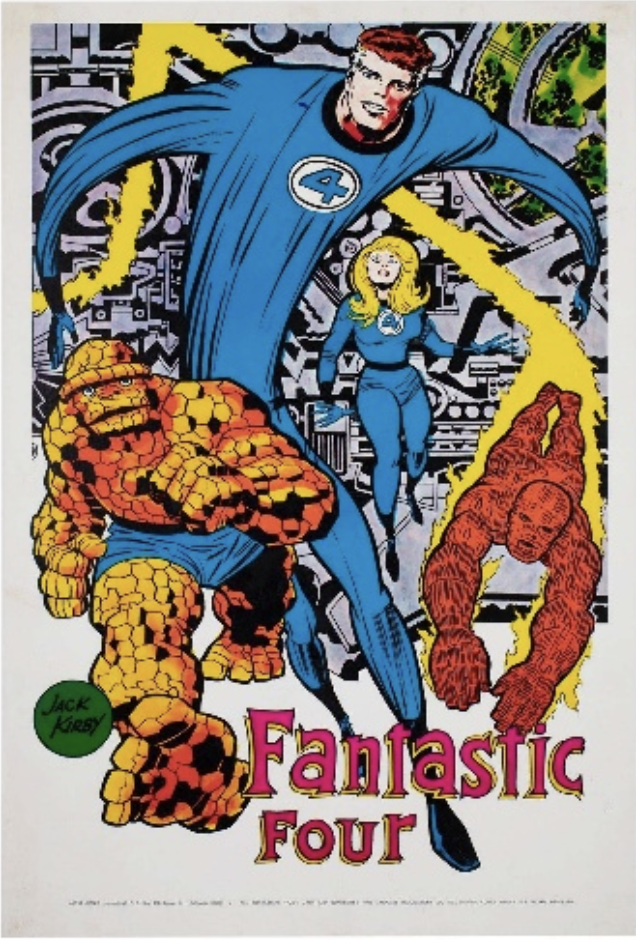
1961. Jack Kirby and Stan Lee were still relatively unknown to the wider public, though both had a track record in comics. Kirby had created Captain America back in the 1940s; Lee, for his part, was a writer with a modest but varied body of work behind him. All of that changed with the publication of Fantastic Four #1, cover-dated November 1961. In that issue the two of them did not merely create four superheroes: they set in motion the universe of modern Marvel, a fictional world that is today a byword for entertainment, fantasy and imagination.
As the legend goes, it all began with a conversation on a golf course between two publishers, one from Marvel and one from DC. The DC man is said to have mentioned the enormous commercial success of the Justice League of America. And since no good idea seems fated to remain alone for long, the Marvel publisher went to his creators and asked them to come up with something similar and — naturally — every bit as profitable. Out of that request came the Fantastic Four: Mister Fantastic, otherwise Reed Richards, a scientific genius able to stretch his body at will; the Invisible Girl, as she was then, Sue Storm, Reed's fiancée and capable, obviously enough, of vanishing from sight; the Human Torch, Johnny Storm, Sue's brother, who could set himself alight, control fire and fly; and the Thing, Ben Grimm, Reed's closest friend, whom the accident that gave them all their powers turned into a rock-skinned monster of superhuman strength.
What might have been a straightforward imitation of DC Comics' near-divine heroes became, thanks to Kirby and Lee's temperament and sensibility, something revolutionary. The Four was as much about the deeply human personalities of its members. Gone were the sometimes one-dimensional characterisations of the DC line. The Four were a family first and explorers of the mysteries of the unknown second — a blend of superheroics and science fiction in which no concept was too vast or too strange to take on. From the macrocosm to the microcosm, often spurred on by Reed Richards's scientific curiosity, Marvel's first family leapt into the abyss of the unknown without a second thought.
Kirby and Lee's unruly imaginations produced some of the most delirious concepts, characters and, of course, supervillains, not just in Marvel but in popular culture at large. Doctor Doom, the Four's greatest adversary and the central villain of the forthcoming Avengers film, is simply the best known and among the most inspired. He is far from the only one. Out of the comic hyperbolically billed as The World's Greatest Comic Magazine came the Black Panther, the Inhumans, Galactus, the Silver Surfer and a great many more.
This exhibition explores sixty-five years of Fantastic Four stories through a wealth of magnificent original artwork, in dialogue with the art of the series' greatest creators — those of the past and those of its still-brilliant present.
Welcome to the unknown. Explore it, and marvel.
Comissário
José Pedro Castello Branco
PARCEIROS
GAMING
MEDIA


HOTEL OFICIAL

PARCEIROS INSTITUCIONAIS



PARCEIROS